Monomials and Polynomials
Monomials, binomials, trinomials and polynomials all describe the number of variables in a function or equation.
Monomials
Monomials are the product of non-negative powers of variables composed of one (mono) term. In other words, a monomial is a single number, variable, or product of numbers and variables with a whole number exponent. For example:
Binomails and Trinomials
Binomials are simply the sum of two monomials. For example:
To get to trinomials, we simply extend to a third term. For example:
Polynomials
Finally, polynomials (poly simply meaning many) are the sum of four or more terms. In practice, trinomials (and binomials) are called polynomials. Using the above example:
Adding (Subtracting) Polynomials
Adding and subtracting polynomials is as simple as combining like terms using the standard order of operations or (video).
It is probably most effective to look at doing this with an example: Add . Here we simply identify like terms. In this case, and (ignoring the coefficients) appear in both elements. Once identified, we simply combine these:
Supplemental Video

Multiplying (Dividing) Polynomials
Note: These examples are from Paul's online math notes
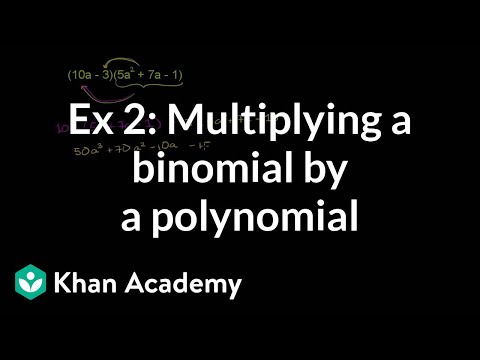
As above, except now we have a few exponent rules to remember (see the summary for a link to a cheet sheat with exponent rules). Using another example, multiple the following: ).
so simple application of the distributive law.
We can add to the complexity a bit with:
Supplemental Video